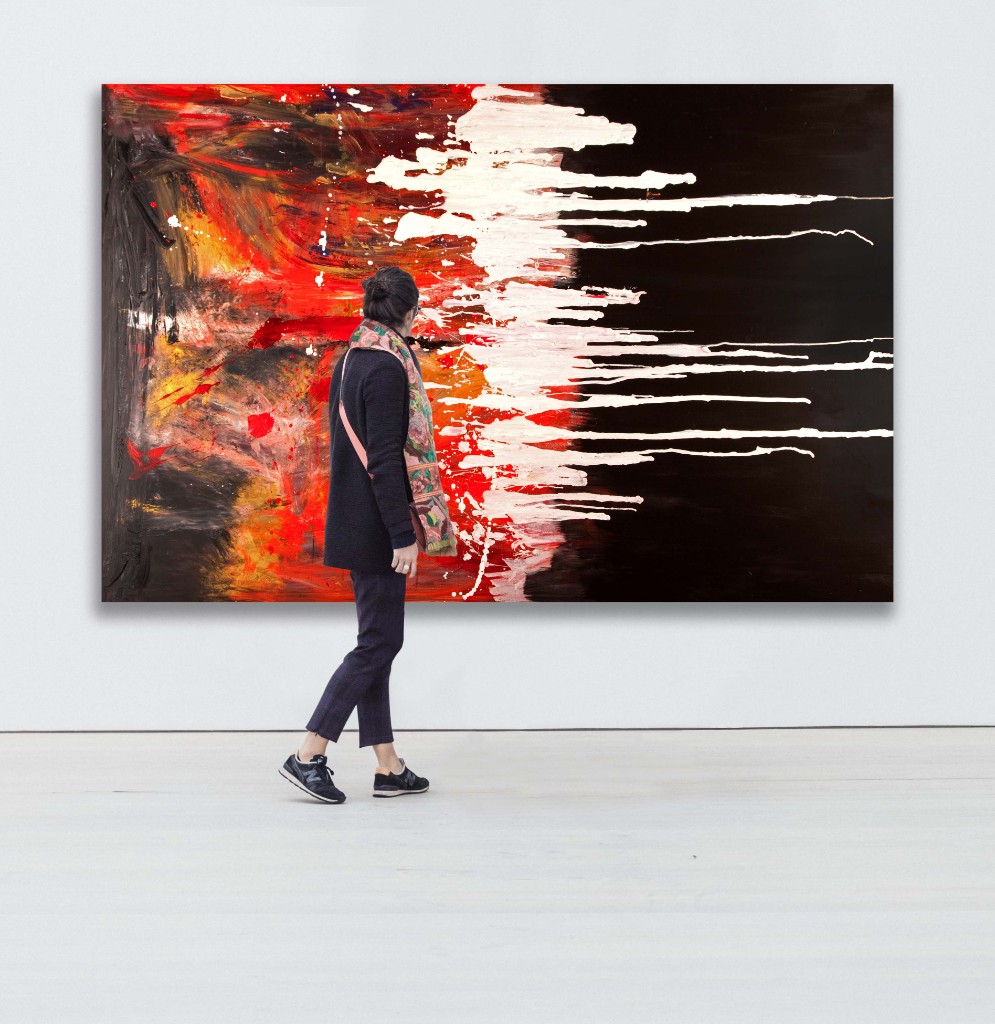
Birth, Sato Bon
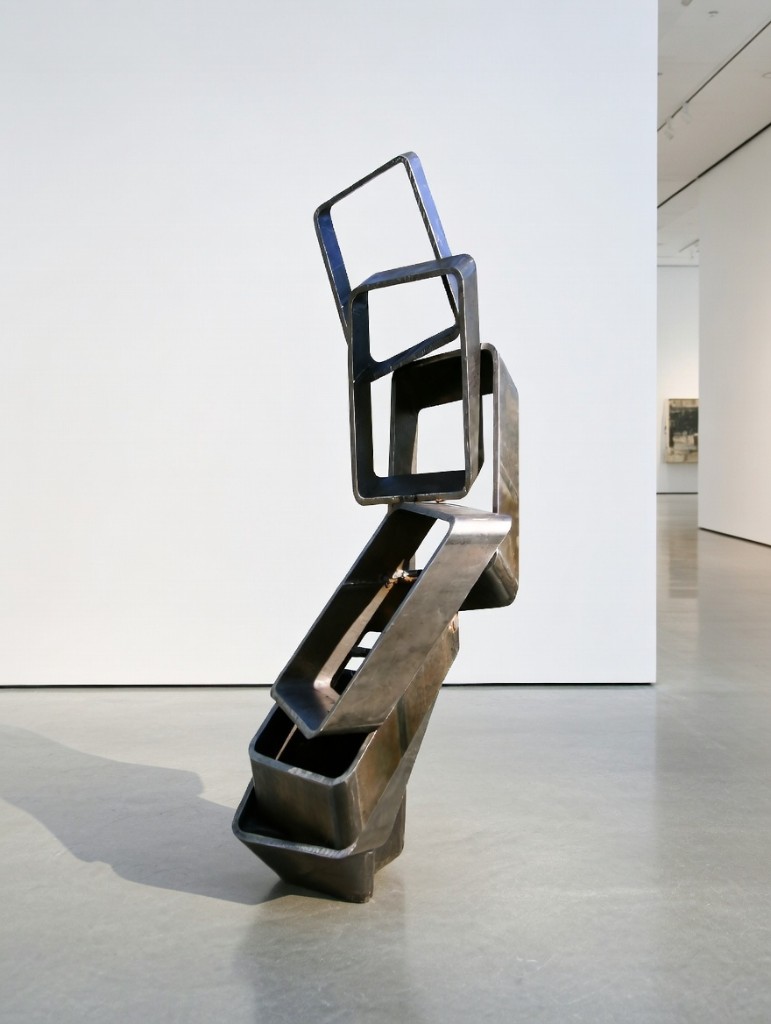
Moments, Sato Bon
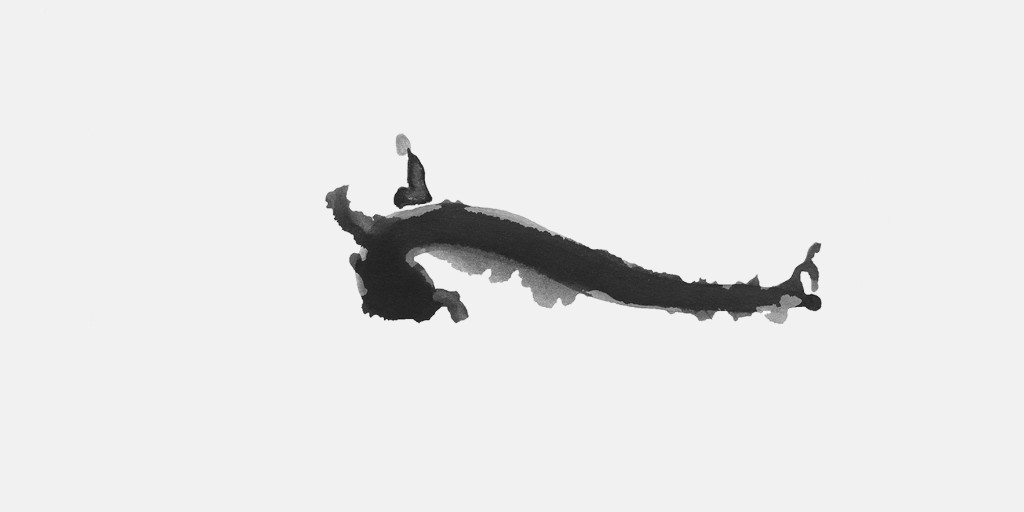
Untitled, Sato Bon
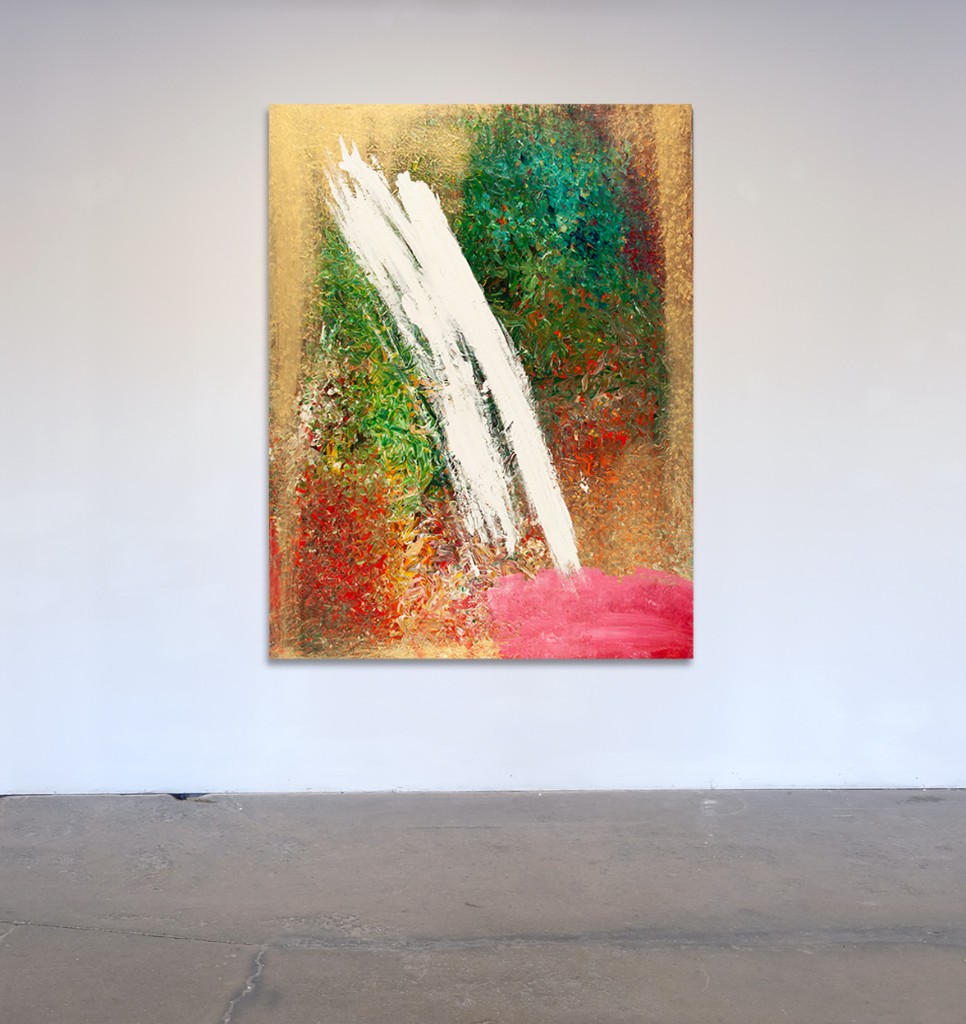
Light, Sato Bon
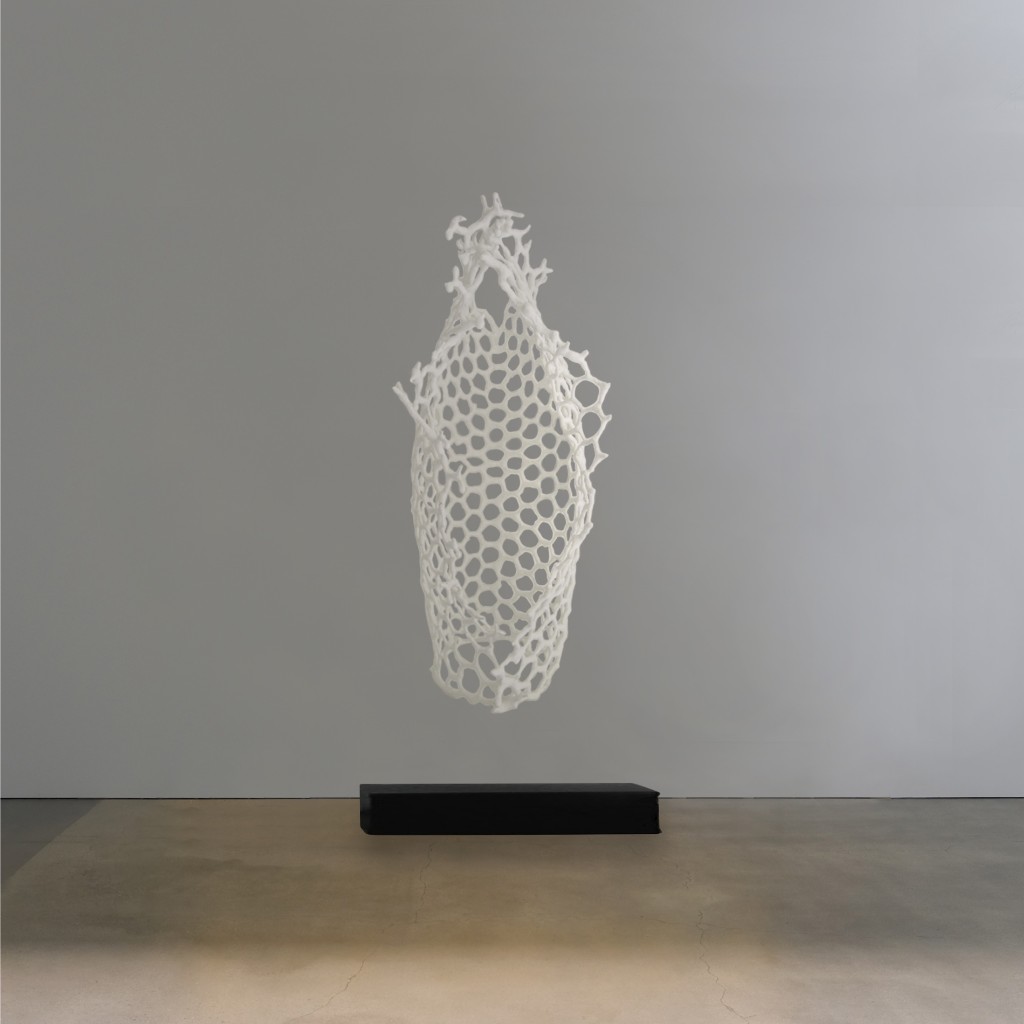
Source, Sato Bon
The oldest art we know goes back at least 67,800 years. A hand stencil in a cave on Muna Island, Indonesia. A simple outline of a hand pressed to rock, pigment blown around it, leaving a negative shape. A mark that says: I was here. I made this. I exist.
That impulse has never stopped.
Art began as a necessity: before there were words for it, there were images, art was the first technology for keeping meaning alive. The cave paintings at Lascaux, horses and bison rendered with extraordinary precision some 17,000 years ago, were purely functional: ways of understanding, preserving, and transmitting what mattered most to the people who made them.
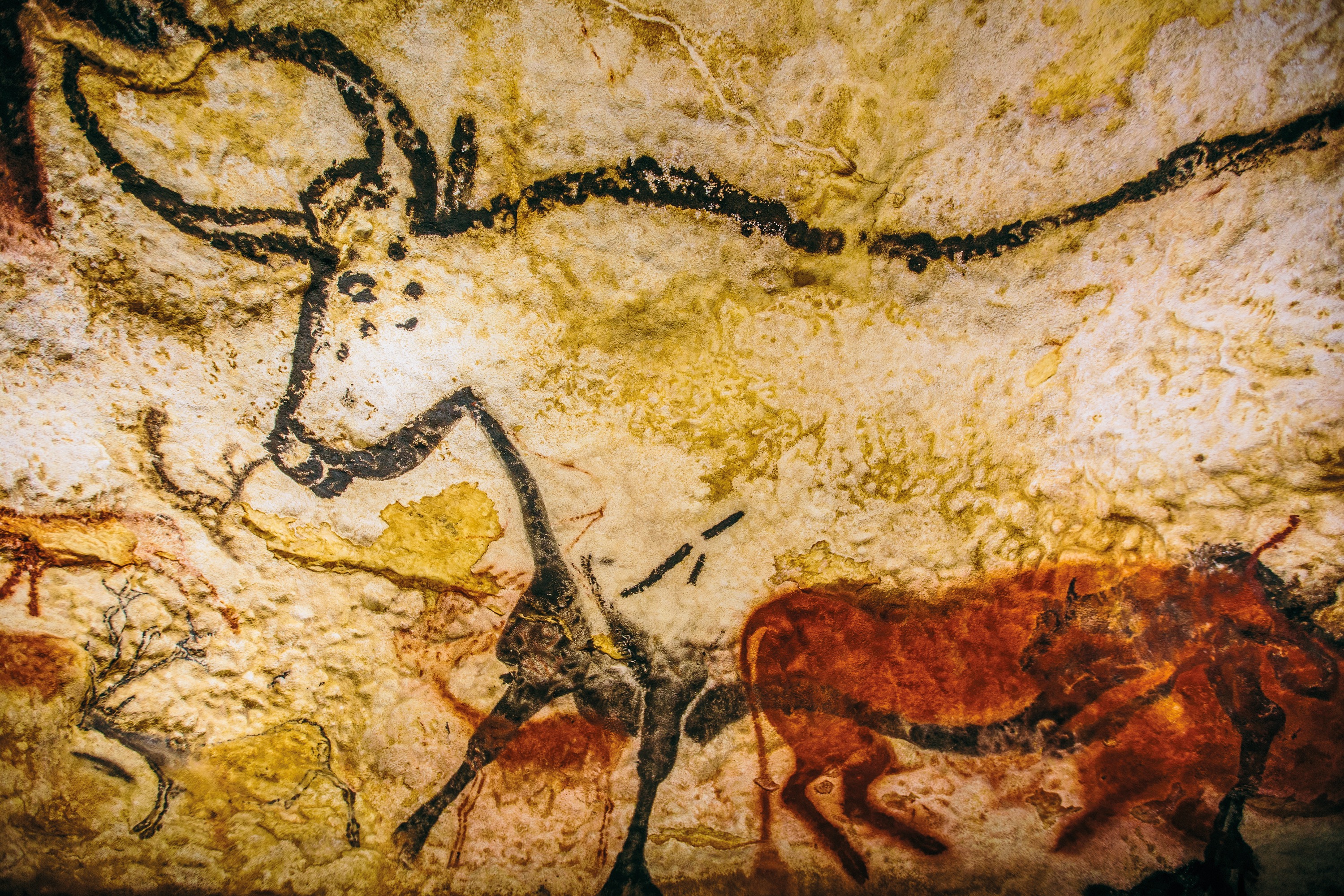
Lascaux cave painting, France, 17,000 to 20,000 years old
Every civilization that wanted to last used art to say so. Pharaohs built colossal statues to make their authority feel cosmic and inevitable. The Church filled its cathedrals with frescoes and stained glass to teach, stir the soul, and convert a largely illiterate population.
In the East, the tradition diverged. Chinese landscape scrolls and Japanese woodblock prints pursued harmony with the natural world rather than dominion over it. Where Western art placed the human figure at the center, Eastern art situated it within a larger order, smaller against mountains, dwarfed by water, at home in impermanence. Philosophies and ways of life rendered in brushstrokes and immersion in the natural world.
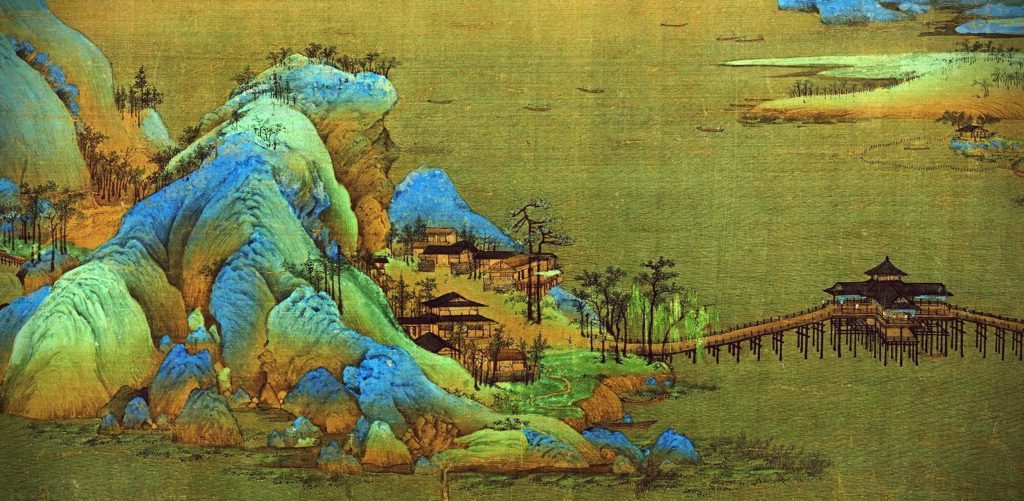
Wang Xi Meng, A Thousand Li of Rivers and Mountains
Then the modern movement arrived and broke the frame entirely. Impressionism dissolved solid form into light and atmosphere; Expressionism turned inward, making raw emotion the subject; Cubism fractured the single viewpoint, insisting that reality is multiple and simultaneous. Every shift in style was a shift in philosophy and culture, a new claim about what reality is and how we perceive it.
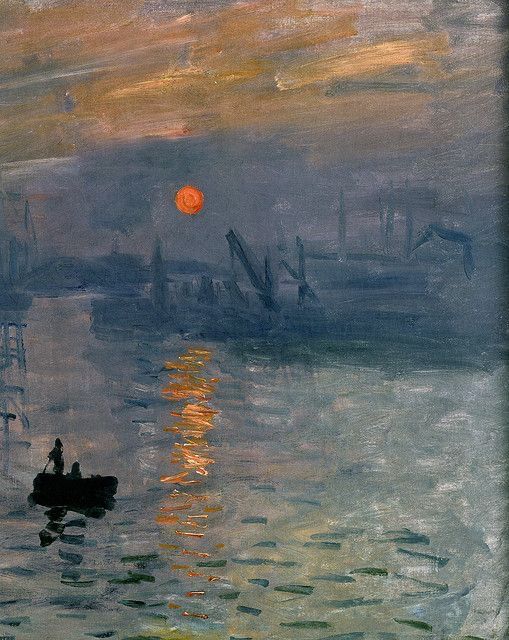
Claude Monet, Impression, Sunrise, 1872
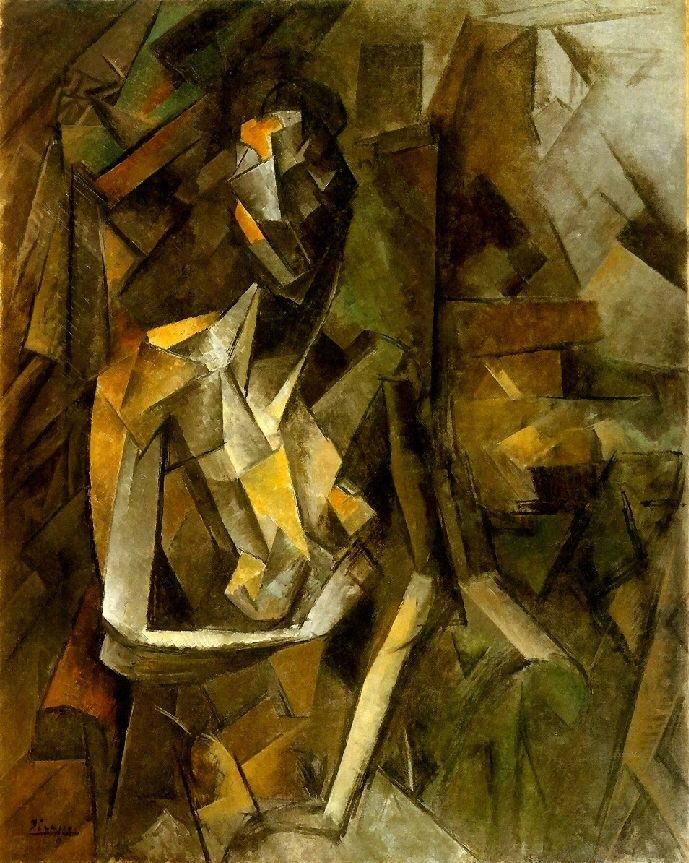
Pablo Picasso, Cubism
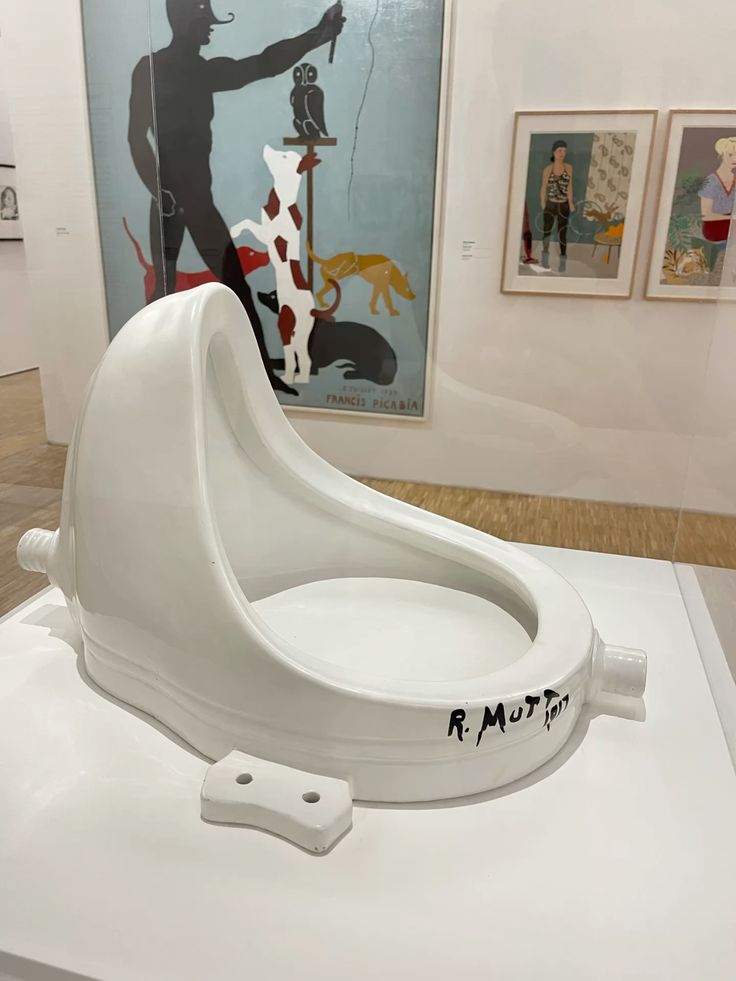
Marcel Duchamp, Fountain, 1917
Dadaism took this further, placing a urinal in a gallery and calling it art. The gesture was calculated: who decides what counts? Who holds the authority to name beauty? These questions, absurd on the surface, cut to the heart of how any society organizes value and meaning. Surrealism plunged inward, into the dream world and the unconscious. And now digital art and AI-generated imagery have reopened every question at once. What is authorship? What is skill? What separates creation from curation? Is digital art slop or evolution?
Rui Huang, Earth 2133
The tools have changed faster than the answers. But the underlying impulse remains constant. Across all of it, from that faint hand stencil in an Indonesian cave to a rendered landscape produced by an algorithm in 2025, art has always been the place where a civilization works out what it believes and aspires to be.
And if we reflect on certain periods of art, we can see their values reflected directly in the culture they produced. The Renaissance is the clearest example. Leonardo da Vinci studied anatomy to understand the human body from the inside out, mapped the forces of water and air, designed machines centuries before they could be built. His work, and that of his contemporaries, emerged from the conviction that human beings were capable of understanding the entire world and even the cosmos, and that art was the discipline through which that understanding became visible. Michelangelo's figures strain toward something beyond the physical.
Raphael's School of Athens places philosophers in a setting of such architectural harmony that reason itself seems to have a home. The Renaissance believed the world could be made beautiful, ordered, and dignified, and its art expressed that belief with total conviction.
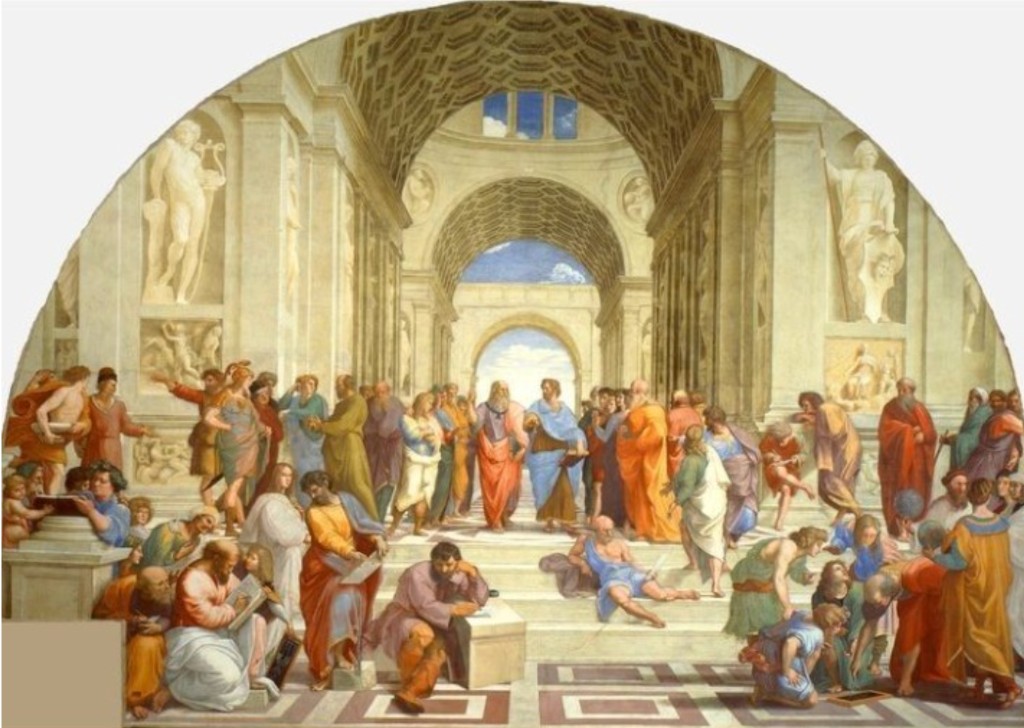
Raphael, The School of Athens, 1509–1511
The culture it produced was warmer for it. Italian piazzas, the proportions of a Brunelleschi dome, the scale of a Renaissance palazzo, these were environments designed to make a human being feel, at the level of the body, that the world was arranged for them. Grand enough to inspire, human enough to inhabit and enjoy.
Then the 20th century systematically dismantled all of it. Minimalism stripped ornament from architecture. The Bauhaus reduced design to pure function. Brutalism built cities in concrete and glass, indifferent to the body and hostile to beauty and the natural world. Conceptual art declared that the idea was enough; craft, skill, and beauty were optional. A blank canvas, a pile of rocks, a fluorescent tube in an empty room: all of it valid, though, none of it feels warm nor human.
The result is the world most of us now inhabit. Glass towers that reflect the sky but reveal nothing. Cities engineered for efficiency and indifferent to the body and human spirit. Public spaces that process people rather than welcome them. Walk through any major downtown built after 1960 and feel it: the absence of warmth, of craft, of anything that invites you to linger. Buildings that age badly because they were never designed to be loved. The culture got the environment its art prepared it for.
Leonardo painted the human face as though it contained an entire interior universe. We replaced that impulse with a urinal in a gallery and called it progress and art.
Art has always been a civilization's self-portrait. The Greeks drew themselves reaching toward perfection. The Renaissance drew humanity as the measure of all things. We scribbled on a urinal and called it genius and a revelation. Look at what we built, and you'll see exactly how that self-portrait turned out.
"It is the function of art to renew our perception. What we are familiar with we cease to see. The writer shakes up the familiar scene, and, as if by magic, we see a new meaning in it." Anais Nin
The ancient Greeks did not see beauty as decoration; they saw it as proof of an order beyond human making.
It was their greatest insight: the recognition that true beauty was never a human invention, but a visible trace of the cosmic order, mathematical, proportional, and eternal, that governed the universe.
Their temples still move us with subtle proportions, their sculptures embody ideal form, and their poetry and philosophy seek harmony in the soul and the creative intelligence of the universe. The Greeks viewed beauty beyond the ornamental; they saw it as a revelation, a trace of order triumphing over chaos, and excellence manifesting itself in the sensible world.
Beauty and taste are not the same thing.
Beauty begins in biology yet reaches toward something more. Evolutionary psychology suggests our preference for symmetry, proportion, and harmony is ancient. Symmetrical features signal genetic health and developmental stability; balanced forms in nature (ripe fruit, healthy foliage) once meant survival. Cross-cultural studies reveal a convergence in perceptions of facial attractiveness: averageness and symmetry consistently emerge as strong predictors of higher ratings across diverse populations. Though tastes and some cultural differences exist, they operate within biologically constrained boundaries rather than overturning these core universals.
The Greeks intuited this instinctively. Exemplars like the Parthenon's subtle curvatures and refined proportions, or Myron's iconic Discobolus (the "Discus Thrower," frozen in poised, dynamic tension), embody symmetria; the measure, balance, and harmonious integration of parts into a unified whole. Aristotle later gave this insight philosophical form, stating that beauty consists in "orderly arrangement, proportion, and definiteness." For the Greeks, such harmony was no arbitrary preference but a participation in cosmic order.
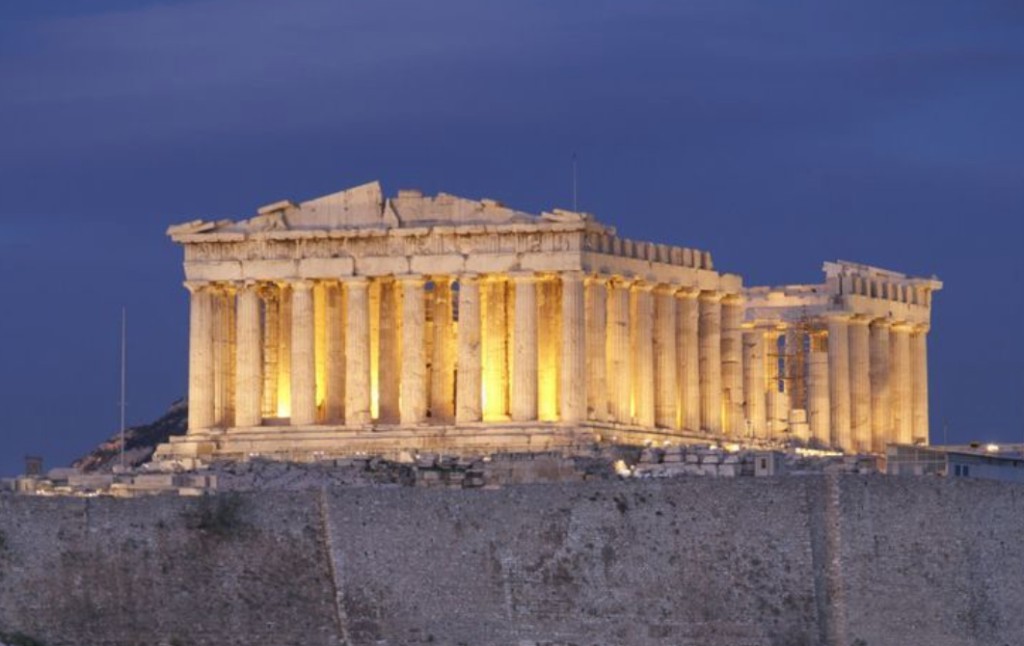
The Parthenon, Athens, embodying symmetria through mathematical precision
We see this cosmic order reflected in nature; the bilateral symmetry of a sunflower's seed pattern, the logarithmic spiral of a nautilus shell, or the balanced aerodynamics revealed in a ballerina's poised dance.
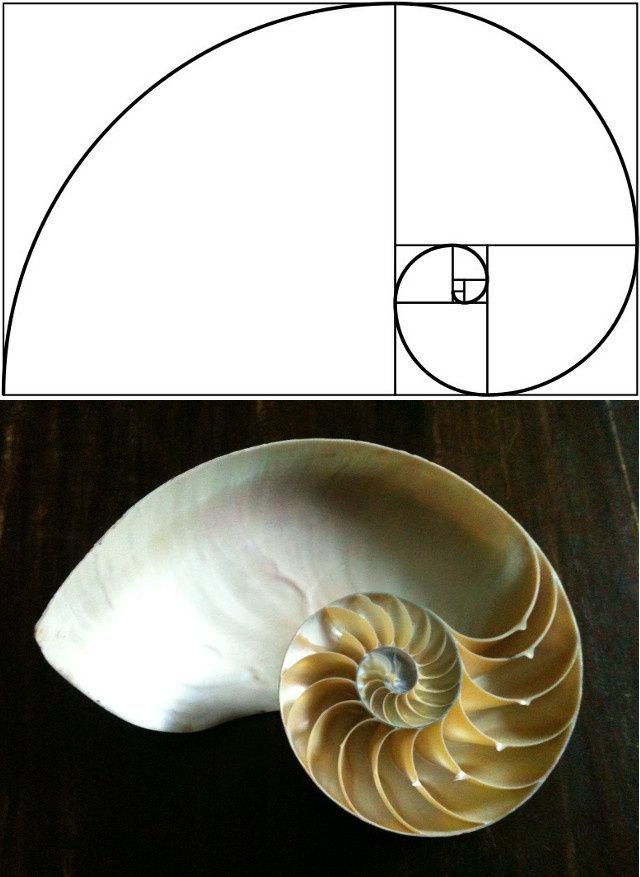
Nautilus shell, nature's logarithmic spiral
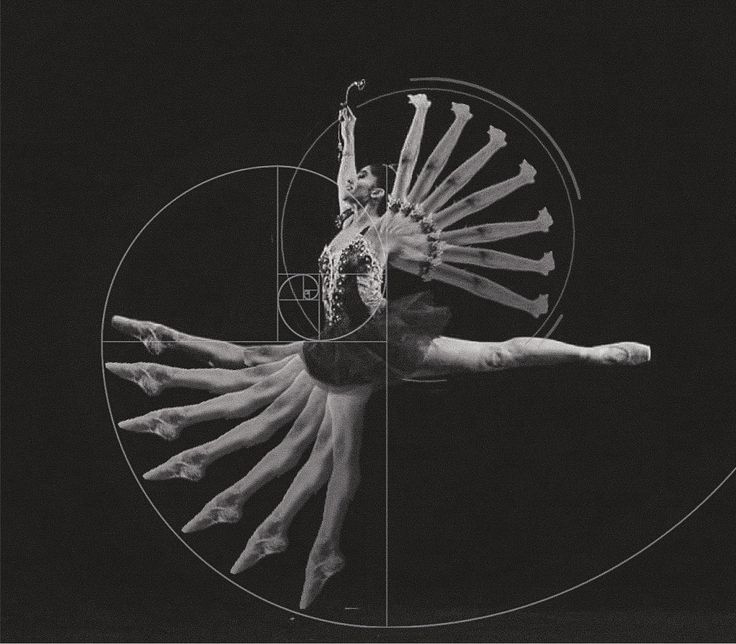
The Fibonacci spiral in a ballerina's poised dance
Plato took this further. In the Symposium, beauty is described as a ladder; from bodily loveliness upward through souls, laws, sciences, to something that neither comes nor goes, neither flowers nor fades. A glimpse of the eternal. For Plato, beauty was far more than decoration, it was the beginning, the first rung of a ladder leading the soul toward truth.
You don't need metaphysics to feel it. When you encounter real beauty; a face, a landscape, a piece of music that hits exactly right; the brain responds immediately. Feel-good chemicals, a lift in mood, a glow. The world suddenly seems ordered, good, full of potential. It happens faster than thought.
Yet aesthetic goodness is not the same as moral goodness. Physical beauty delivers immediate, disinterested pleasure, it is pure delight with no agenda. Morality by contrast demands restraint, sacrifice, or difficult choices. Still, the two converge in moments of grace. A virtuous act carried out with poise, empathy, and quiet strength becomes radiant, noble, and beautiful. Regular encounters with beauty, nature's symmetries, and music's perfect resolutions awaken self-transcendent feelings, temper our narrow self-interest, and draw us toward higher values. In this way, aesthetic refinement, in all its forms, becomes an ally to ethical growth. Beauty makes the good worth pursuing.
Taste is what beauty becomes through discipline.
Beauty shows up through objective qualities like proportion, harmony, and symmetry that we can rationally understand. While we start with our senses, real appreciation needs trained judgment to properly see these patterns. Taste, then, is aesthetic excellence built through innate attunement, habit, and practice. Poor taste swaps quick thrills for lasting value. Good taste finds the sweet spot between overindulgence and under-appreciation, opening us to forms that feed the soul and help us thrive as humans.
Our preferences begin in raw, unreasoned bursts of rapture, love at first sight, or sensory intoxication that leaves us wordless. These moments imprint deeply, they arrive unjustified and pure. Over time, through repeated encounters, reasoned comparison, and immersion in culture's best offerings, they ripen into refined habits of seeing and feeling. Pretense (admiring what others esteem without an inner spark) dulls and distorts it. Genuine taste, by contrast, grows saner and more open-hearted through lived delight and joy.
Taste can be cultivated, but not by everyone equally.
Some are born with a natural sensitivity toward aesthetic delight, finer antennae for harmony, proportion, or resonance, much as some are born with a keener ear for music. This innate quality provides a head start; refinement is less about mechanical memorization than about awakening what was already there. But taste can also be acquired through deliberate, patient effort, it is not an exclusive birthright. Anyone willing to engage honestly with beauty over time can develop it, though realism matters; the depth reached by someone born with that predisposition is not always reachable by those who must cultivate it through effort alone.
That said, consider two pianists, both rigorously trained. One plays well, technically solid and expressive. The other, gifted with an innate musicality, becomes a genius. Both practice countless hours. Yet the one with that inner quality achieves a luminous, transcendent level the other cannot quite match. The difference lies not in effort alone, but in how readily and profoundly beauty registers from the start. In either case, what matters is that the pursuit is taken seriously.
In essence, natural sensibilities for taste make discernment easier. Without this foundation, the journey requires greater patience and persistence, but remains no less rewarding for those willing to undertake it with honest engagement.
They feed each other.
A refined sense of beauty sharpens taste; it teaches you to tell genuine excellence from novelty or trend. And taste, once developed, becomes the lens through which you recognize beauty in its most subtle forms. The pianist with innate musicality hears beauty immediately and deeply; taste teaches the rest of us to hear it too, in works that might initially seem opaque or demanding. Beauty opens you, taste guides you. Neither works without the other.
In an age of infinite generated content, taste becomes the only compass.
As algorithms flood us with generated images, music, and designs, the human capacity for genuine aesthetic discernment becomes our most vital faculty. Machines can replicate patterns and optimize for engagement metrics with a single click. Yet only human taste can discern the subtle nuances that move us deeply, the kind of beauty that only shows up when something was actually hard to make, and the forms that resonate with our shared humanity instead of programmed tastes. In an era of infinite machine-generated content, cultivated taste becomes our compass towards what nourishes the human spirit.
The ancients were not sentimental about beauty, they were serious. They understood that a people who stop cultivating beauty stop cultivating themselves, and that a civilization indifferent to beauty is already in decline.
In our AI age, where algorithms can generate infinite content, these ancient insights become our most important defense. The stakes have not changed; beauty remains our deepest orientation, toward order, toward truth, toward what truly endures. And taste is the cultivated discipline that transforms perception into meaningful engagement with those same enduring qualities of truth.
A civilization that can no longer recognize beauty has forfeited something deeper than an aesthetic preference; it has lost the language through which it once spoke the truth about itself.
"The chief forms of beauty are order and symmetry and definiteness, which the mathematical sciences demonstrate in a special degree." Aristotle, Metaphysics, Book XIII
Civilizations aren't defined by the tools they build, but by the meaning of those tools.
Each major invention has carried within it a claim about human potential, what we thought ourselves capable of, what we feared, and how far we believed the species could reach. We are now building something that forces that reckoning again, and in a more direct form than it has ever taken before.
In late 2022, when systems like ChatGPT first emerged publicly, the responses divided sharply. Some recognized the outline of something genuinely transformative, others dismissed those readings as premature. Three years on, the early patterns are no longer theoretical.
Within the next 12 to 24 months, AI is expected to become central to how most industries operate. The "if" question has given way entirely to "how fast"; and more importantly, "what kind of civilization do we intend to be when it does?" What values do we protect? What roles do we insist remain human? And what new worlds become possible when machines absorb so much of the cognitive labor that once defined us?
The Long Pattern
Technology has always been the catalyst for human evolution. The first hand imprint, the wheel, the printing press, the steam engine, the telephone: each tool stood as humanity's philosophical statement about what we believed ourselves capable of achieving. These were never instruments of convenience alone, they expressed a civilization's self-image: its values, its fears, and the extent of its belief in human potential.
Looked at closely, the pattern holds in each case. When the printing press began to move, it dismantled the monopoly on knowledge and ignited centuries of intellectual revolution. The steam engine didn't expand industry so much as it collapsed the idea of distance, rewriting what a human being could reach in a single lifetime. Every major technological shift has carried within it a vision of our humanity: what we are, what we need, and what we aspire to become.
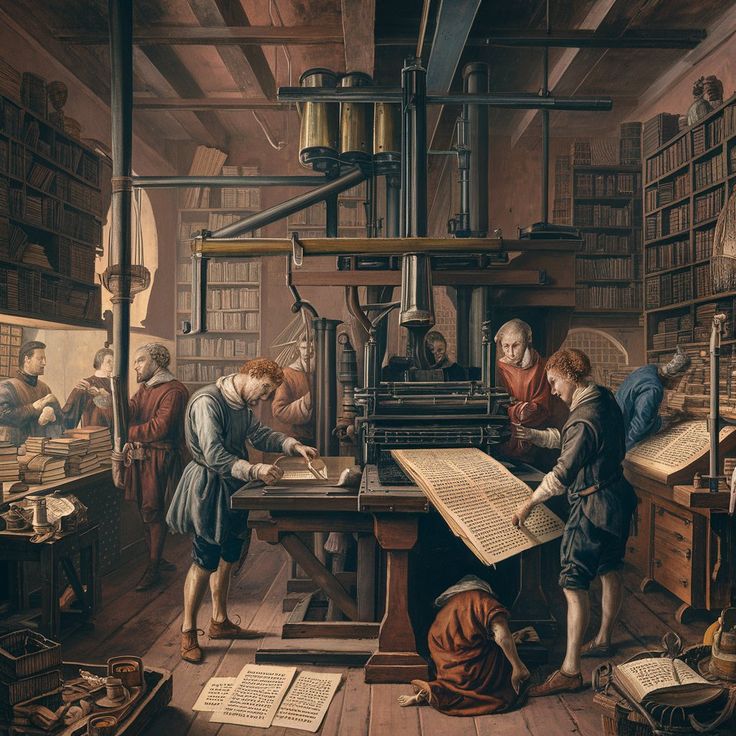
Gutenberg's printing press, the technology that dismantled the monopoly on knowledge
In our timeline, AI arrived carrying its own radical vision: boundless creation, imagination unbound by flesh, intelligence no longer tethered to a single mind or lifetime. Yet perhaps even more transformative than what AI can do is the story it forces us to tell about ourselves; our evolving role in creation, and our redefined place in the cosmos.
The Gains, and Their Cost
The gains are real and significant; they are civilizational leveling, they matter more than people realize, and mark the beginning of a new epoch, perhaps even comparable to the discovery of fire.
AI compresses time. What once demanded years of accumulated expertise now lies within reach of a single determined mind. The young artist in a provincial city commands tools that would have rivaled the finest studios a decade ago. The scholar without access to great libraries can interrogate centuries of thought in an afternoon. For the first time in history, the barrier between an idea and its realization is closer to one's will than to circumstance.
But gains always have their opposite balance. In the case of AI, this means that as machines seep more into our work and lives, the need for labor is drastically reduced, and so too will how we perceive the natural world and beauty. When experience becomes mediated and optimized, the capacity for raw, unmediated wonder is among the first things lost.
What Work Meant
Across millennia, work, especially when infused with purpose, has been the engine of human progress and personal fulfillment. The labor of innumerable hands raised monuments, carved cathedrals, built cities, and preserved knowledge through the ages.
Yet the deeper significance of our species emerges only when effort aligns with a cause greater than the self. This truth ranks among the oldest and most reliable secrets to a meaningful life: to dedicate oneself to a purpose that transcends personal gain. When we do, our significance stretches beyond individual limits and endures long after we are gone.
To strip labor of these higher dimensions risks eroding the very foundations of personal identity and society. At its best, work is never drudgery; it becomes a bridge linking a loved and well-lived life to the enduring stream of human achievement. When we labor on behalf of what outlasts us (family, community, art, knowledge, or the patient advancement of civilization), we participate in the ongoing creation of reality and the cosmos.
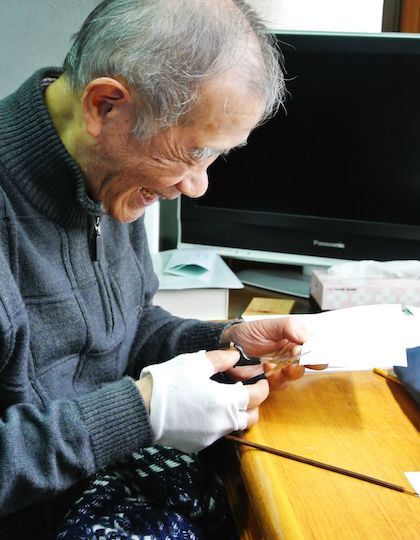
A craftsman at work, the dignity of purposeful human labor
The builders of the great medieval cathedrals knew they would not live to see the spires completed. They laid stone for children not yet born, for a glory that would outlast every name carved into it. That is what purposeful labor has always meant at its highest: not the exchange of time for wages, but the willingness to be part of something that continues without you.
That is the dimension of human life that AI places most directly at risk: not wages or productivity, but the older and harder question of what we are building, and why.
What Comes Next
As AI absorbs the cognitive labor that once required vast numbers of workers, the workforce contracts sharply. Teams of fifty become teams of five. The rigid architecture of the 9-to-5 dissolves, replaced by something more fluid: schedules shaped by outcomes, availability, and the natural rhythms of human life instead of the clock.
This contraction goes well beyond a pursuit of efficiency or the trimming of costs. It represents a fundamental reconfiguration in the very structure and meaning of human work and life.
Those who no longer need to labor in the old sense can now pursue that freedom without the old penalties; the stigma of idleness, the poverty, the loss of dignity that once came with enforced leisure.
Instead, the surplus AI creates could free people to pursue what distinguishes the civilized life from survival mode: the arts of contemplation, the creation of beauty, the pursuit of wisdom, the deepening of human bonds, and the transmission of culture to the next generation.
But for some, the free time provided by AI dividends will not be enough. Even with a floor of income drawn from the abundance automation creates, some will want more, and will want, in some form, to work and create their own income.
The question is what this looks like for those who want more.
The answer could lie in Ronald Coase, the economist who argued that when property rights are clearly defined, resources flow to their highest use through voluntary exchange. Applied here, each person could hold clear rights over their own "human corpus"; the unique record of their behavior, preferences, likeness, and accumulated life experiences. That corpus would become recognized property, allowing individuals to license those rights on their own terms to the corporations that need them.
By default, that value flows away from the people who generated it. A Coasian future would reverse that direction.
Perhaps the answer is that people will get a choice; a salary from the state or from companies, drawn from the surplus AI creates, and alongside it, an independent income earned by licensing what only you possess, your blueprint.
That combination, collective abundance and individual agency, may create a more abundant life in a post-automation world.
But this vision rests on a condition that history has rarely honored: that the surplus gets shared.
The Industrial Revolution generated extraordinary wealth, but at a steep cost: child labor, slum-ridden cities, and decades of hardship for those who fueled its engines, long before prosperity reached them. Unlike that era's windfall, the fruits of AI will not share themselves equitably. Without deliberate structures, the freedom described here will belong to some and not others, dividing along the same fault lines of class, geography, and circumstance that have always determined who gets to live the examined life and who simply endures.
And even for those who do inherit this freedom, history offers a warning of its own.
Yet here lies the recurring peril of history and the conundrum of existence.
Leisure without purpose is the seed of decay; civilizations have withered when abundance replaced necessity and people, relieved of toil, surrendered to the undisciplined pleasures of the senses or the mind's indolent wanderings. The gift of time, if not ennobled by voluntary discipline and a purpose beyond the self, be it family, community, philosophy, science, or the patient cultivation of a richer existence, may breed enervation and ennui instead of a renaissance and wisdom.
Rome offers the clearest mirror of all. The grain dole fed the city and pacified its crowds, while the games siphoned off the last sparks of civic vitality. A people who had built aqueducts, codified enduring laws, and driven roads through mountains now poured their genius into the Colosseum's ephemeral blood sports and crowd-pleasing spectacles.
The challenge is to make this liberation worthy of our humanity: to channel freed time toward education in its truest sense, rather than toward credentials. Wisdom, beauty, truth. Perhaps then we will at last find the space to know who we truly are.
It has been done before. Socrates taught in the open air of the Athenian agora, drawing young minds into conversation about virtue, justice, and what a human life is for. And in doing so, showed that the deepest learning arises from curiosity when depth is earnestly sought. The Florentine academies of the fifteenth century gathered scholars, artists, and philosophers around the same questions and produced the Renaissance as a consequence. The great libraries of Baghdad and Cordoba preserved and transmitted the Greek inheritance across centuries of European darkness, ensuring that Aristotle's logic, Euclid's geometry, and Plato's idealism survived to shape the modern world. Heritage never transmits itself automatically; it requires people who have the time, the devotion, and the deep conviction that what came before is worth carrying forward.
That capacity; for transmitting what matters across time; is exactly what AI frees us to reclaim.
AI, at its best, is the tool that finally gives us that time.
If we succeed, the machines' gift may mark our ascent and not decline: humanity relieved of drudgery, at last free to pursue its nobler calling as builder and guardian of humanity's light and spirit.
Technology has always reflected our values, our story, our will as a species. The real question has never been what technology can achieve, but what we think it ought to serve; nobility or our baser appetites. The mirror AI holds up to our civilization will not lie, what it shows us depends entirely on what we choose to build.
"We have created a civilization based on science and technology and have not bothered to ensure that it is committed to the values that make us human." Carl Sagan
